
Waveform Analysis of Pokémon X & Y’s Snowbelle City
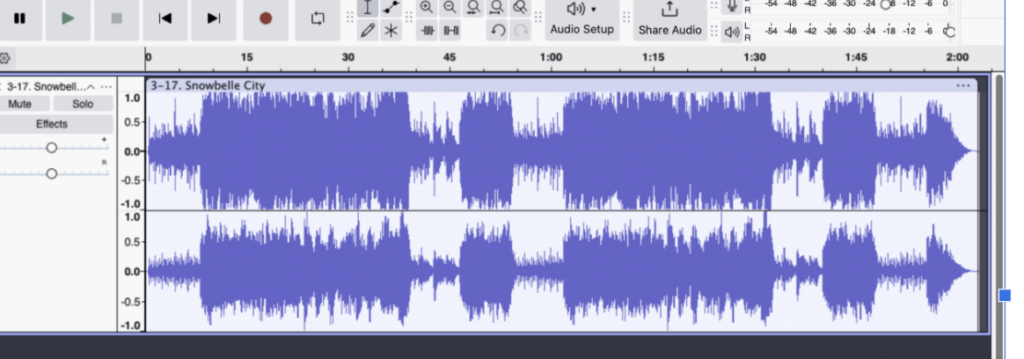
In my analysis of Pokémon X & Y’s Snowbelle City theme, I explored how moments of slight silence and the ADSR envelope of specific sounds contribute to the track’s immersive quality. By adjusting the decibel threshold and time settings in Audacity, I identified a mid-track near-silence from approximately 39s to 45s that functions as a natural transition between musical phrases. This brief moment of softer melody enhances the piece’s dynamic structure, much like a lull in snowfall before the wind picks up again. The contrast between these softer sections and the surrounding instrumentation creates a sense of ebb and flow, reinforcing the wintery atmosphere of the city. This intentional use of the slight silence makes the environment feel more organic, mirroring the unpredictable yet serene nature of a snow-covered landscape.
Additionally, I examined the ADSR (Attack, Decay, Sustain, Release) envelope of a distinct bell-like chime that repeats throughout the melody, such as from 54s to 60s. This sound plays a crucial role in shaping the emotional tone of the piece. The chime has a quick attack, meaning it reaches full volume almost instantly, giving it a crisp and bright presence that stands out against the softer ambient sounds. Its short decay ensures that the initial hit is not too harsh, allowing the note to settle smoothly into the soundscape. The sustain phase is gentle, maintaining a shimmering, airy quality that contributes to the track’s delicate, almost fragile beauty. Finally, the release is fairly long, with the note fading gradually rather than cutting off abruptly. This creates a lingering effect, much like how sound carries in a quiet, snowy environment.
The combination of these ADSR characteristics gives the chime an ethereal, icy quality that perfectly complements Snowbelle City’s wintery aesthetic. The quick attack mirrors the sharpness and crispness of cold air, while the extended release mimics the way sound seems to stretch and resonate in a snow-covered landscape, where ambient noise is naturally absorbed. Emotionally, this chime evokes a deep sense of nostalgia and tranquility, reinforcing the town’s peaceful, almost otherworldly atmosphere. Through the use of silence and dynamic contrast, Snowbelle City’s theme does more than set the mood—it creates an awe-inspiring auditory experience that makes players feel as though they are wandering through a serene, snow-laden world.
This analysis of Pokémon X & Y’s Snowbelle City theme reinforces my core argument that game soundscapes are not just passive background elements but active participants in storytelling and immersion. It demonstrates how sound design can evoke emotion, enhance spatial awareness, and create a sense of place. Just as nature-inspired soundscapes in games like Breath of the Wild use environmental audio to make the world feel alive, the careful crafting of Snowbelle City’s music—through moments of near-silence and ethereal chimes—draws players into its wintery atmosphere. The way sound behaves in this track mirrors the unpredictability of nature itself, reinforcing the idea that audio in games is more than just a static composition—it’s a living, breathing force that deepens player connection and immersion. This highlights why the evolution of interactive music, dynamic composition, and environmental storytelling, is so significant; the industry continues to recognize and refine the role of sound as a crucial component of world-building and emotional engagement.
Transcription Analysis of Animal Crossing New Leaf (3DS) – 1 AM – Rainy.mp3
import pretty_midi
from collections import Counter

# Load the MIDI file
midi_data = pretty_midi.PrettyMIDI("/content/acnl1AMRainy_basic_pitch.mid")

# Extract all notes from all instruments
all_notes = []
for instrument in midi_data.instruments:
    all_notes.extend([note.pitch for note in instrument.notes])

# Count note occurrences using Counter
note_counts = Counter(all_notes)

# Get the most common notes
most_common_notes = note_counts.most_common(10)

# Print the results
for note, count in most_common_notes:
    print(f"Note: {pretty_midi.note_number_to_name(note)}, Count: {count}")
Output
Note: D#7, Count: 35
Note: F#6, Count: 32
Note: B6, Count: 29
Note: B5, Count: 26
Note: G#6, Count: 25
Note: C#6, Count: 21
Note: C#7, Count: 19
Note: E6, Count: 18
Note: F#5, Count: 16
Note: A6, Count: 5
The note frequency analysis of Animal Crossing: New Leaf’s 1 AM Rainy theme highlights the delicate, dreamlike atmosphere that makes this track so immersive. The most common note, D#7, appears 35 times, which immediately stands out because of its high pitch. This suggests a shimmering, bell-like texture—possibly from a vibraphone or soft synth—that gives the piece its signature ethereal feel. Alongside F#6 (32 times) and B6 (29 times), these frequent high notes create a floating, almost weightless quality, reinforcing the theme’s sleepy, late-night mood. They likely form the core of the melody or embellishments that drift in and out like the gentle rhythm of raindrops.
The presence of B5 (26 times) and G#6 (25 times) adds warmth and stability to the soundscape, keeping it from feeling too sharp or piercing. These notes may help outline the main chords, subtly grounding the track while still allowing space for the higher, twinkling tones to shine. Meanwhile, C#6 (21 times) and C#7 (19 times) hint at a strong tonal center, possibly indicating that the piece leans into a C#-based key or harmonic progression. This repetition likely gives the track a sense of familiarity, making it feel comforting and hypnotic over time.
Lower but still frequent notes like E6 (18 times) and F#5 (16 times) help round out the arrangement, softening the transitions between higher notes and reinforcing the underlying harmonies. A6 (5 times) is the least common among the top ten, showing it might be used more for variation—maybe as a passing note or subtle accent to add a bit of movement to the melody. Adding slight variations I believe may help add a more fluid and contemplative nature to the composition.
Altogether, this distribution of notes suggests that ACNL’s 1 AM Rainy soundtrack creates its calming effect through gentle repetition and a balanced blend of high, chime-like tones with mid-range harmonic support. The frequent D#7 and F#6 notes give the track a sparkling, rain-like texture, while the slightly lower tones provide warmth and fluidity, preventing it from feeling too cold or distant. This combination captures the feeling of wandering through a quiet, rain-soaked village at night, where everything is still, and the only sound is the soft patter of raindrops against the rooftops. It’s soothing, reflective, and a little melancholic—which is perfect for a game designed to make even the quietest moments feel meaningful.
This analysis of Animal Crossing: New Leaf’s 1 AM Rainy theme further supports my argument that game soundscapes are carefully designed to evoke deep emotional experiences and enhance player immersion. The deliberate use of high, chime-like notes mimics the gentle rhythm of falling rain, while the warm, mid-range harmonies prevent the track from feeling too distant or sterile. Much like the way Pokémon X & Y uses dynamic composition to create a sense of place, this piece demonstrates how even a simple note frequency distribution can shape a player’s perception of the game world. The soundtrack doesn’t just accompany the experience—it becomes the experience, reinforcing the solitude and peaceful melancholy of a rainy night in-game. As game audio evolves, it continues to blur the line between sound and storytelling, making virtual spaces feel as real and emotionally resonant as the world outside.
Data Visualizations
Google Ngram

Looking at the Google Ngram data, I see a clear trajectory in how concepts related to video game audio and environmental storytelling have evolved over time. The terms “interactive music” and “dynamic composition” show peaks and declines, suggesting that academic and industry discourse around these ideas has shifted. Interactive music saw a major rise in the late 1990s and early 2000s, likely paralleling the development of more sophisticated game engines that could handle adaptive audio. Meanwhile, dynamic composition gained traction in the early 2000s and peaked slightly later, reflecting growing interest in music that responds to gameplay in real time.
What’s most interesting to me is the steady rise of “environmental storytelling” in recent years. This aligns perfectly with my argument: game audio is no longer just about setting the mood—it’s an integral part of world-building and emotional immersion. The increase in discussion around environmental storytelling suggests that developers and scholars alike are recognizing how soundscapes, dynamic audio, and interactive elements work together to create a more compelling, lived-in game world. I think about games like Breath of the Wild, where the ambient soundscape—whether it’s the rustling of grass, distant wildlife, or the absence of music in open landscapes—creates a powerful sense of presence.
The relatively lower frequency of “video game soundtrack” and “game sound design” in comparison to the other terms also tells me something: discussions about game audio have evolved beyond just traditional music composition. Instead of simply focusing on static soundtracks, developers and researchers are now exploring how music and sound design can interact with player agency and environmental storytelling. This shift supports my argument that nature-inspired soundscapes, dynamic composition, and psychoacoustic techniques are becoming more central to the gaming experience.
Ultimately, the Ngram data reinforces what I already suspected—game audio is evolving into a more immersive, interactive, and emotionally resonant experience. It’s not just background noise; it’s an essential tool for storytelling, world-building, and emotional connection.
Scatter Plot: Tracking Duration Across Moods in Pokémon X/Y
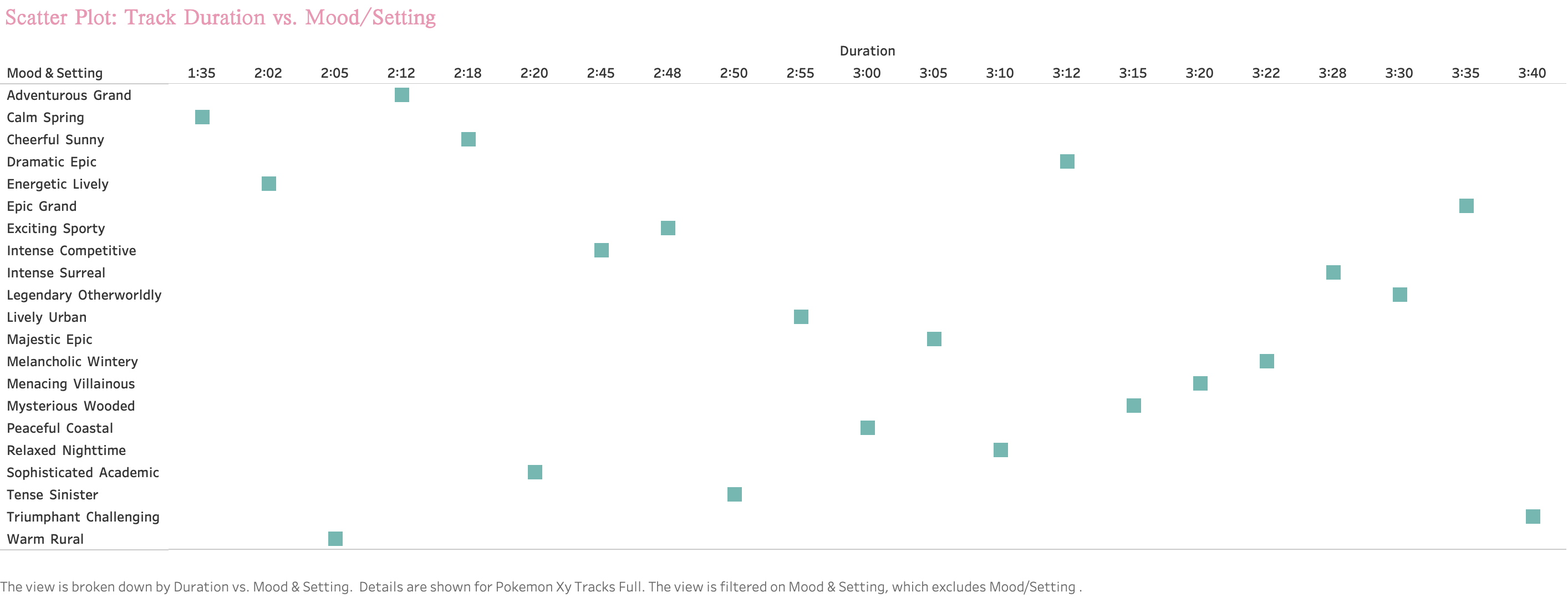
The scatter plot visualizing track duration versus mood/setting provides insight into how different musical pieces in the Pokémon X/Y soundtrack contribute to emotional experiences. By mapping track duration along the x-axis and categorizing moods/settings on the y-axis, this visualization helps identify whether certain emotional tones are associated with longer or shorter tracks. For instance, more intense or “Epic Grand” moods may correlate with extended compositions, reinforcing a sense of grandeur, while lighter “Cheerful Sunny” tracks may be shorter, aligning with fleeting moments of joy in gameplay.
This is relevant to my core idea and argument regarding how nature-inspired soundscapes create immersive emotional experiences. Music in games is not just background noise—it is an integral part of storytelling, shaping the player’s emotional journey through atmospheric effects and dynamic composition. The scatter plot indirectly reflects this by showing the structural choices behind different moods. Longer durations might indicate themes of adventure, exploration, or emotional depth, whereas shorter tracks could signify quick transitions or momentary excitement. Hence, this data visualization underscores the role of musical structure in crafting an engaging, believable game world, reinforcing the emotional connection players form with the digital environment.